introduction to claude monet
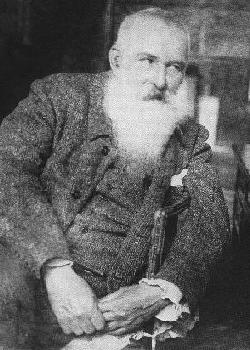
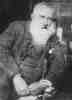 Oscar-Claude Monet
 (1840-1926) is a famous French painter and one of the founders of the Impressionism movement along with his friends Renoir, Sisley and Bazille.
Monet rejected the traditional approach to landscape painting and instead of copying old masters he had been learning from his friends and the nature itself. Monet observed variations of color and light caused by the daily or seasonal changes.
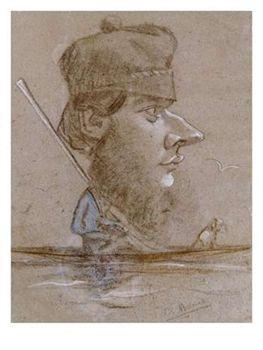
Claude Monet was born on November 14, 1840 on the fifth floor of 45 rue Laffitte,in the ninth arrondissement of Paris. He was the second son Claude Adolphe Monet and Louise-Justine Aubree. On the first of April 1851, Monet entered the Le Havre secondary school of the arts. He became known locally for this charcoal caricatures, which he would sell for ten to twenty francs. Monet also undertook his first drawing lessons from Jacques-Francois Ochard, a former student of Jacques-Louis David. On the beaches of Normandy in about 1856/1857 he meet fellow artist Eugéne Boudin who became his mentor and taught him to use oil paints. Boudin taught Monet "en plein air" (outdoor) techniques for painting.
BIOGRAPHY:
- 1840
- Birth of Claude Oscar MONET on November 14th in Paris.
- 1845
- The family moves to Le Havre.
- 1857
- Death of his mother Louise Monet.
- 1858
- Claude Monet meets Eugène Boudin who encourages him to paint out of doors.
- 1859
- Monet comes to Paris and enters the Swiss Academy.
- 1860
- Monet meets Pissaro and Courbet.
| 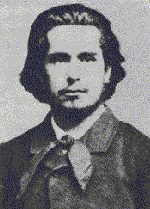
1860 - photo Carjat |
- 1863
- Monet discovers Manet's painting and paints "en plein air" in the Fontainebleau forest.
- 1864
- Monet stays in Honfleur with Boudin, Bazille, Jondkind. He meets his first art lover : Gaudibert.
- 1865
- Monet's paintings are submitted for the first time to the official Salon. Camille Doncieux his lady
friend and Bazille pose for Le Dejeuner sur l'herbe (the Picnic).
- 1867
- Birth of his first son Jean Monet while Claude Monet is in Sainte-Adresse.
| 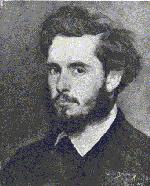
1867 portrait by Carolus Duran |
- 1868
- Monet tries to commit suicide. He receives a pension from Mr Gaudibert. He paints in Fecamp and
Etretat.
- 1869
- Monet settles in the village of Saint-Michel near Bougival where he paints in company of Renoir.
- 1870
- Monet marries Camille, Courbet is his witness. They take refuge in London when the war begins.
- 1871
- Monet meets Durand-Ruel in London with Pissaro and Daubigny. Death of his father. Monet settles
at Argenteuil after visiting the Netherlands.
| 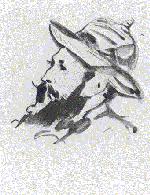
1874 by Manet |
- 1873
- Monet meets Caillebotte.
- 1874
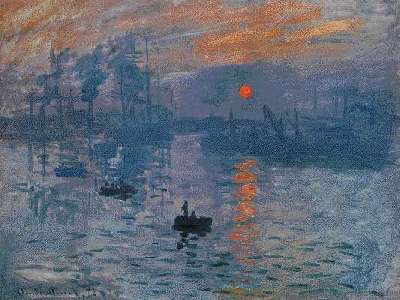
- Monet exhibits "Impression : sunrise" at the first Impressionist exhibition in the studio of Nadar.
- 1876
- Monet meets Ernest and Alice Hoschedé.
- 1877
- Bankruptcy of Ernest Hoschedé. Monet paints the Saint-Lazare train station.
| 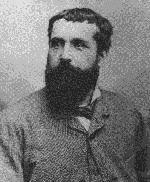
1880 |
- 1878
- Birth of Michel Monet, his second son. Monet and his family settle at Vétheuil in compagny of the
family Hoschedé.
- 1879
- Death of Camille.
- 1881
- The family moves to Poissy.
| 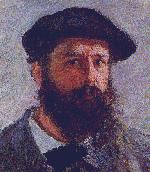
1886 self-portrait
with a beret |
- 1883
- Monet rents a house at Giverny. He will stay there for 43 years.
- 1887
- Monet exhibits in New-York thanks to Durand-Ruel.
- 1889
- Monet exhibits with Rodin.
- 1890
- Monet purchases the house in Giverny and begins the digging for the nympheas basin.
| 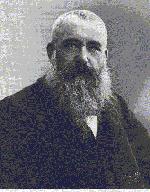
1899 Photo Nadar |
- 1891
- Death of Ernest Hoschedé. Monet paints the series of Meules (Haystacks) and of Peupliers
(Poplars)
- 1892
- Monet paints the Rouen Cathedrals series. He marries Alice in July.
- 1894
- Visit of Mary Cassatt and of Cézanne at Giverny. Rodin, Clémenceau and Geffroy are present.
- 1900
- Monet paints several views of the Japanese bridge. He takes several trips to London and paints
views of the Thames.
| 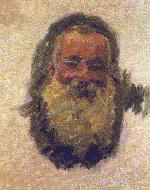
1917 Self-portrait |
- 1904
- Monet travels to Madrid and admires the paintings of Velasquez.
- 1907
- First problems with his eyesight. Monet discovers Venice.
- 1911
- Death of Alice.
- 1914
- Death of Jean, Monet's eldest son. Blanche moves to live near Claude Monet.
| 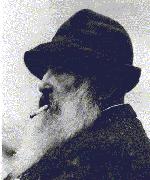
ca. 1920 by
Henri Manuel |
- 1916
- The artist decides to build a large studio of 23 m x 12m at Giverny.
- 1916 - 1926
- Claude Monet works on twelve large canvas, The Water Lilies. Following the signing of the
Armistice, Monet offers to donate them to France. Theses paintings will be installed in an
architectural space designed specifically for them at the museum of the Orangerie in Paris.
- 1923
- Monet is nearly blind. He has an operation from the cataract in one eye. His sight improves.
| 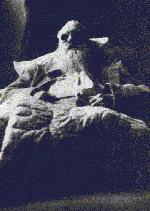
ca. 1923 |
- 1926
- In February Monet is still painting. But he suffers from lung cancer. He dies on December 5th.
He is buried in a simple ceremony at Giverny. His friend Georges Clémenceau attends the
ceremony.
-
- MONETS EXPLORATION:
IMPRESSIONISM- Impressionism is a movement in French painting, sometimes called optical realism because of its almost
scientific interest in the actual visual experience and effect of light and movement on appearance of objects.
Impressionist motto - human eye is a marvelous instrument. Impact worldwide was lasting and huge. The
name 'Impressionists' came as artists embraced the nickname a conservative critic used to ridicule the whole
movement. Painting 'Impression: Sunrise' by Claude Monet fathered derogatory referral. Impressionist
fascination with light and movement was at the core of their art. Exposure to light and/or movement was
enough to create a justifiable and fit artistic subject out of literally anything. Impressionists learned how to
transcribe directly their visual sensations of nature, unconcerned with the actual depiction of physical objects
in front of them. Two ideas of Impressionists are expressed here. One is that a quickly painted oil sketch
most accurately records a landscape's general appearance. The second idea that art benefits from a naïve
vision untainted by intellectual preconceptions was a part of both the naturalist and the realist traditions, from
which their work evolved
- PRINCIPLE OF IMPRESSIONISM: PAINTING

Techniques of the Impressionists: Broken Color Painting © Jerry Fresia - artist out of the studio and into nature as source.
- Broken color refers to a painting technique 'invented' by the Impressionists that is still used today by
some artists. Technically speaking, it goes like this: suppose I have an index card that is a permanent
light green color. You can see it from across the room easily enough. Yup. That is green alright.
Now we take an index card that is half, say, cerulean blue, and half cadmium yellow light. I put a
hole in the middle of the card and I spin it like crazy. In principle, from across the room you will see
a similar green but this time the green has more energy. It is alive. It mixes optically at a distance.
That is what broken color is suppose to achieve – the actual sensation of light itself. But without
the point of view, the technique is rather empty and vacuous. It is like the dreadful 'style' where
someone who thinks they are using an Impressionist method and simple makes a lot of little dabs to
create an effect, albeit a rather dead one at that.
IMPORTANT !!!!!!! 10 PRINCIPLE OF IMPRESSIONISM
-
The Impressionists used a perceptive method in their brush strokes choosing colors with
minimal pigment mixing, allowing the eye of viewers to optically mix the colors as they looked
at the artwork from a distance.
-
Impressionist’s paintings retain an overall luminosity in their paintings by avoiding blacks and
dark earth colors as shades, instead they mixed darker shades of blues and violets with
complementary colors.
-
It must be noted that Impressionist used Black, but only as a special color in its own right.
The impressionists also simplified their compositions, omitting detail to achieve a striking
overall effect.
-
The Impressionists often painted wet into the wet paint instead of waiting for succeeding
colors applications to dry, this process created softer edges and intermingling of shimmering
color.
-
Impressionist for the most part avoided the use of thin paints to create glazes like the old
masters. Rather the Impressionists put paint on canvas expressively and thickly and did not
rely upon layering techniques in the same fashion of their predecessors.
-
Impressionists give special emphasis to aspects of the play of natural light, together with an
acute awareness of how colors reflect from object to object-called Reflected Light and how
colors show through semi-transparent things called Translucent Light.
-
In outdoor paintings, called “plein air” describe the act of painting in the outside environment
rather than indoors (such as in a studio setting). So that they could observe nature more
directly and set down its most fleeting aspects—especially the changing light of the sun.
-
The Impressionist confidently painted shadows with the blue of the sky as it reflected onto
surfaces, which gave a wonderful sense of freshness and openness. The impressionists also
simplified their compositions, omitting detail to achieve a striking overall effect.
-
The Impressionist found their subject matter around them rather from history, like their
predecessors. Instead of focusing on ideal of beauty they tried to depict what they saw
at a given moment, capturing a fresh, original vision. Their compositions were simplified
omitting detail to attain a striking overall visual effect.
-
The characteristic features of impressionism are appearance of spontaneity, through
broken brushstrokes of bright, often unmixed colors. Producing a loose or densely textured
surface rather than the carefully blended colors and smooth surfaces favored by most artists
of the time.
ASPECTS IN IMPRESSIONISM: Play of light and colourMore importantly, they learned to build up objects out of discrete flecks and dabs of pure harmonizing or contrasting colour, thus evoking the broken-hued brilliance and the variations of hue produced by sunlight and its reflections. Forms in their pictures lost their clear outlines and became dematerialized, shimmering and vibrating in a re-creation of actual outdoor conditions. And finally, traditional formal compositions were abandoned in favour of a more casual and less contrived disposition of objects within the picture frame. The Impressionists extended their new techniques to depict landscapes, trees, houses, and even urban street scenes and railroad stations.
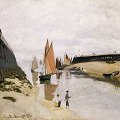 The first steps toward a systematic Impressionist style were taken in France in Monet's coast scenes from 1866 onward, notably the "Terrace" (1866), in which he chose a subject that allowed use of a full palette of primary colour. The decisive development took place in 1869, when Monet and Renoir painted together at the resort of La Grenouillere on the Seine River. The resulting pictures suggest that Monet contributed the pattern of separate brushstrokes, the light tonality, and the brilliance of colour; Renoir the overall iridescence, feathery lightness of touch, and delight in the recreation of ordinary people. Working at Louveciennes from 1869, Pissarro evolved the drier and more flexible handling of crumbly paint that was also to be a common feature of Impressionist painting.
eXPLAINATION FOR IMPRESSIONISM:
-
Claude Monet's Impression SunriseIn the late 1860s, Claude Monet (1840-1926), Pierre-Auguste Renoir (1841-1919) and others
painted in a new style, called Impressionism by contemporaries. The name was first used by
critics, viewing a new exhibition held in 1874, and was directed precisely — and derisively —
at a painting by Monet of a harbor at dawn, which he titled Impression: Sunrise. This painting
is a striking example of the new style. How did Monet achieve the effect in this particular
painting.
- The sun is perceived differently is different parts of our mind. To the more primitive subdivisions
- of our brain, the sun is nearly invisible. But to the primate subdivision, the sun appears normal.
- Thus, there is an inconsistency between our perception of the sun in the primitive and primate
- portions of our brain. The sun is poorly defined and ambiguous to the portion of our brain that
carries information about position and movement.
| Brain subdivision | Subdivision purpose | The sun is… |
| primitive | movement & position | nearly invisible |
| primate | color | an orange disc |
EXAMPLE OF IMPRESSION PAINTINGS
 REFERENCES:
|
|
|

No comments:
Post a Comment